Coding Its Own Future: Can Europe Reduce Its Dependence on American and Chinese AI?
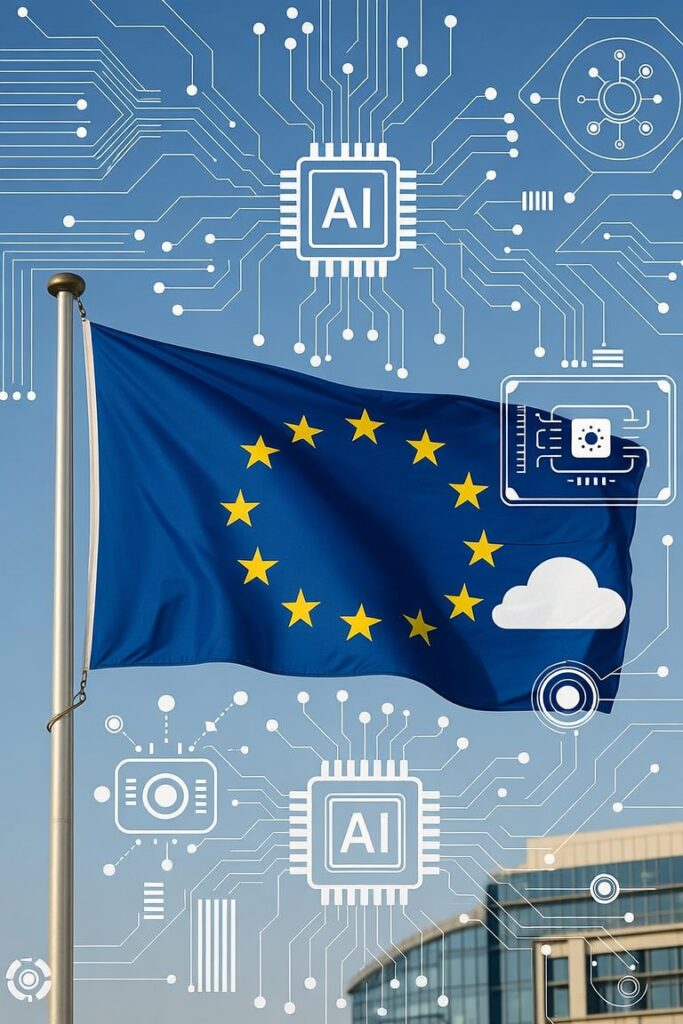
Artificial intelligence has become the layer underneath almost everything else — search, customer service, scientific research, defense planning. Yet the foundation models most of the world builds on come overwhelmingly from a small number of American companies, with Chinese labs close behind and rapidly closing the gap. European companies, hospitals, and governments increasingly run their software and store their data on American cloud platforms, meaning that even purely European applications often depend on infrastructure, and therefore rules and exposure, controlled abroad. Reducing this dominance is less about matching the biggest labs model-for-model and more about ensuring Europe has genuine options and isn’t structurally locked into infrastructure it doesn’t control.
Building European AI Models
France’s Mistral AI and Germany’s Aleph Alpha have shown that competitive language models can be built in Europe, even if neither currently matches the scale of the very largest American labs. Their existence matters less because they’ll necessarily lead the field, and more because they give European governments, companies, and citizens an alternative that operates under European data protection law and isn’t subject to a foreign government’s export controls or content policies.
The honest challenge is capital: training frontier models costs hundreds of millions to billions of dollars in compute alone, a scale that American labs have raised through both private markets and, in some cases, direct hyperscaler backing. European public and private investment has grown but still lags well behind. Whether Europe needs its own frontier-scale lab at all, versus strong models in specific domains (multilingual European-language models, industrial and scientific applications) is itself a live debate — the latter may be a more realistic and still strategically valuable goal.
Data Centers on European Soil
Training and running AI models requires enormous data center capacity, and much of what serves European users today is owned by American hyperscalers, even when physically located within EU borders. Expanding genuinely European-owned data center capacity, and pairing it with the energy investments discussed elsewhere in this series, addresses both a digital sovereignty concern and a physical infrastructure gap, since European data center capacity has struggled to keep pace with the sudden surge in AI compute demand.
Where these centers get their power matters as much as where they’re located: data centers are extraordinarily energy-hungry, and building them without the parallel expansion of nuclear, renewable, and grid capacity described in Europe’s energy strategy risks straining electricity systems rather than strengthening them.
Sovereign Cloud Solutions
Beyond data centers themselves, the software layer that runs on them — cloud computing platforms — is dominated by three American companies controlling the large majority of the global market. European alternatives and initiatives like Gaia-X have attempted to create a genuinely European cloud ecosystem, with mixed results so far, partly because switching away from established American platforms is technically disruptive and partly because European providers have struggled to match their scale and feature depth.
A more incremental path that has gained traction is requiring “sovereign cloud” options for government and sensitive sector use — arrangements where data stays under European jurisdiction and control even if the underlying technology stack originates from an American provider operating under European legal terms. This doesn’t fully solve dependency, but it addresses the most acute legal and security risks while European-native alternatives continue to mature.
Public Datasets
AI models are only as good as the data they’re trained on, and Europe has a genuine asset here that is currently underused: vast public datasets held by governments, hospitals, and research institutions across 24 official languages, representing linguistic and cultural diversity that American and Chinese models, trained predominantly on English and Mandarin content respectively, don’t capture as well.
Making this data available for AI training, under proper privacy safeguards and consent frameworks, could give European models a genuine edge in serving European languages and contexts. The tension is real: Europe’s strong data protection rules, which are themselves a valuable competitive and ethical asset, can also slow the assembly of the large training datasets that modern AI development requires. Resolving that tension without abandoning privacy protections is one of the harder policy balances in this entire agenda.
Supercomputers
Training frontier AI models and running large-scale scientific simulations both require supercomputing capacity, and Europe has made real progress here through the EuroHPC initiative, which has funded systems like Finland’s LUMI and Italy’s Leonardo, among the most powerful supercomputers in the world.
The remaining gap is less about the systems existing and more about who has access to them and for what: much of this capacity has historically been allocated to scientific research rather than commercial AI model training, and the specialized AI chips (still mostly American-designed, per the semiconductor discussion above) that power the most competitive systems remain a dependency of their own. Expanding both the scale of European supercomputing and its availability to European AI developers is a natural extension of the investment already underway.
Conclusion
Europe is unlikely to unseat American and Chinese AI leadership at the very frontier within the next decade, and it may not need to. A more realistic goal is reducing structural dependency: models, data centers, cloud infrastructure, datasets, and computing capacity sufficient that Europe has real alternatives and isn’t forced to run its hospitals, courts, and critical infrastructure on systems it neither owns nor controls. That kind of resilience, built across all five fronts at once, matters more than winning any single leaderboard.